

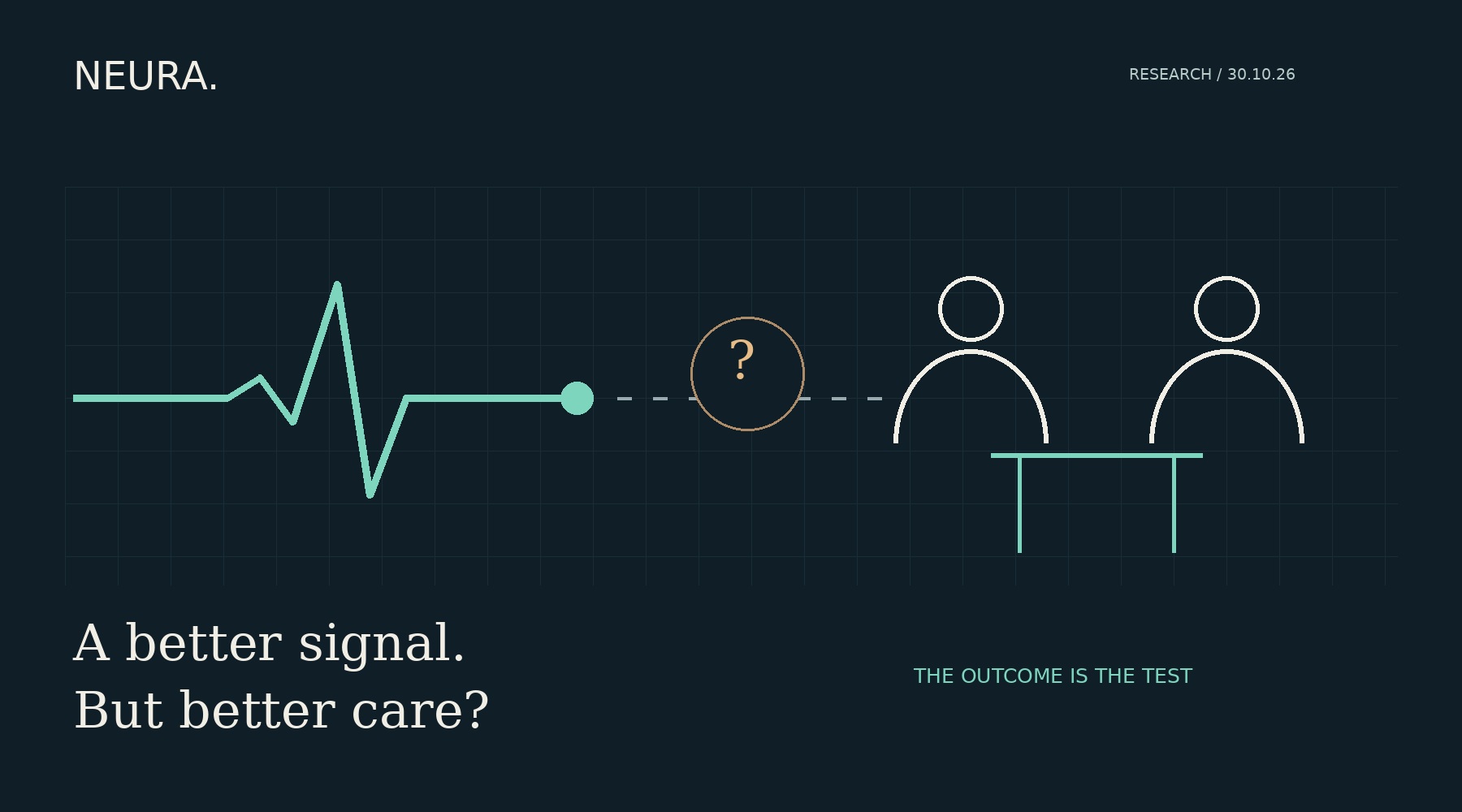
An alert can be accurate without changing what happens to a patient. A medical explanation can be clearer without proving that treatment became more effective. Those distinctions are not reasons to dismiss artificial intelligence in medicine. They are how we decide what a result actually earns.
Two studies reported this month bring the question into focus. One examined wearable monitoring after heart-failure hospitalization. The other examined plain-language summaries before a neurosurgical consultation. They tested different interventions and different outcomes; they should not be ranked as competing products. Together, they illustrate why “AI improved care” is too broad a headline without a named measure.
The signal and the hospital visit
LINK-HF2, published online in JACC: Heart Failure on October 9, analyzed 171 participants at five US Veterans Affairs medical centers. All wore a multisensor patch for up to 90 days. In the intervention group, AI notifications reached clinicians alongside a structured response pathway; the control group’s notifications were not shared with the care team.
The intervention group had a lower rate of AI-detected physiological instability. But the exploratory heart-failure rehospitalization analysis did not show a statistically significant benefit: 13 of 80 participants versus 17 of 91, with a hazard ratio of 0.90 and a 95% confidence interval of 0.43–1.84.
This was a feasibility study, not a definitive verdict on whether monitoring can help. Its uncertainty leaves room for materially different effects. Workflow integration and uncertainty about responding were reported implementation barriers. The authors’ disclosures also identify industry relationships, including employees of Prolaio.
The distinction is practical: a change in a model-defined signal is not interchangeable with fewer hospital returns. Nor does an inconclusive clinical result prove that the intervention has no effect.
A narrower benefit worth recognizing
AI-INFOCARE, reported in NEJM AI on October 15, tested a different task. TU Dresden’s account describes 300 neurosurgical outpatients randomly assigned to usual care or an additional AI-generated, plain-language summary of their medical records before consultation. Patients receiving summaries rated the interaction more positively, while median consultation time was 25 minutes rather than 33.
The published protocol specified human verification of summaries against the source documents. That matters: the intervention was a supported clinical workflow, not an invitation to substitute an unchecked chatbot for a clinician.
The Dresden researchers caution against generalizing across specialties and settings. They did not assess long-term clinical effects. Their disclosure notes that a senior author co-founded the software company, while not participating in patient interviews, data collection or statistical analysis.
A better conversation is a meaningful outcome in its own right. It does not have to be inflated into a claim of longer lives to deserve attention. Equally, shorter appointments alone should not become a mandate to shorten everyone’s time with a doctor.
NEURA analysis: follow the whole chain
The question for a hospital is not simply whether a model can recognize a pattern. It is what the service will do with that pattern. Who receives the alert? Who checks it? Which actions are available? How will the team know whether the action helped rather than added another interruption?
For a document-summary service, the corresponding questions are equally concrete. Who verifies that an important qualification survived simplification? Can the patient ask about an unfamiliar phrase? Can a clinician correct the summary without losing the original? A polished paragraph is the beginning of that workflow, not its completion.
These are design questions and editorial inferences, not findings that either trial settled. They help separate a product demonstration from a care pathway that can be evaluated.
Three questions before the next headline
First, name the outcome. Detection accuracy, patient understanding, appointment duration and hospital admissions answer different questions. Improvement in one should not silently stand in for another.
Second, name the comparison and the people studied. A controlled trial in one specialty may support a focused change there while leaving other settings unresolved. Randomization strengthens a comparison; it does not make its population universal.
Third, identify the remaining uncertainty. A small study’s nonsignificant result is not proof of equivalence. A positive experience score is not evidence of an unmeasured health benefit. Neither observation is an excuse to ignore what the study did establish.
Medical AI deserves neither automatic celebration nor automatic dismissal. It deserves claims that stay the same size as the evidence—and implementations that measure what happens after the prediction.