

A proof can be checked before anyone has written a good explanation of it. That is the position mathematicians are in after Levent Alpöge announced on November 20 that, working with Claude, he had found a proof of the Riemann hypothesis and its generalized version for Dirichlet L-functions. He released a Lean formalization. The first thing to look at is not a screenshot of a successful build, but the checks that tie the code to the mathematical claim.
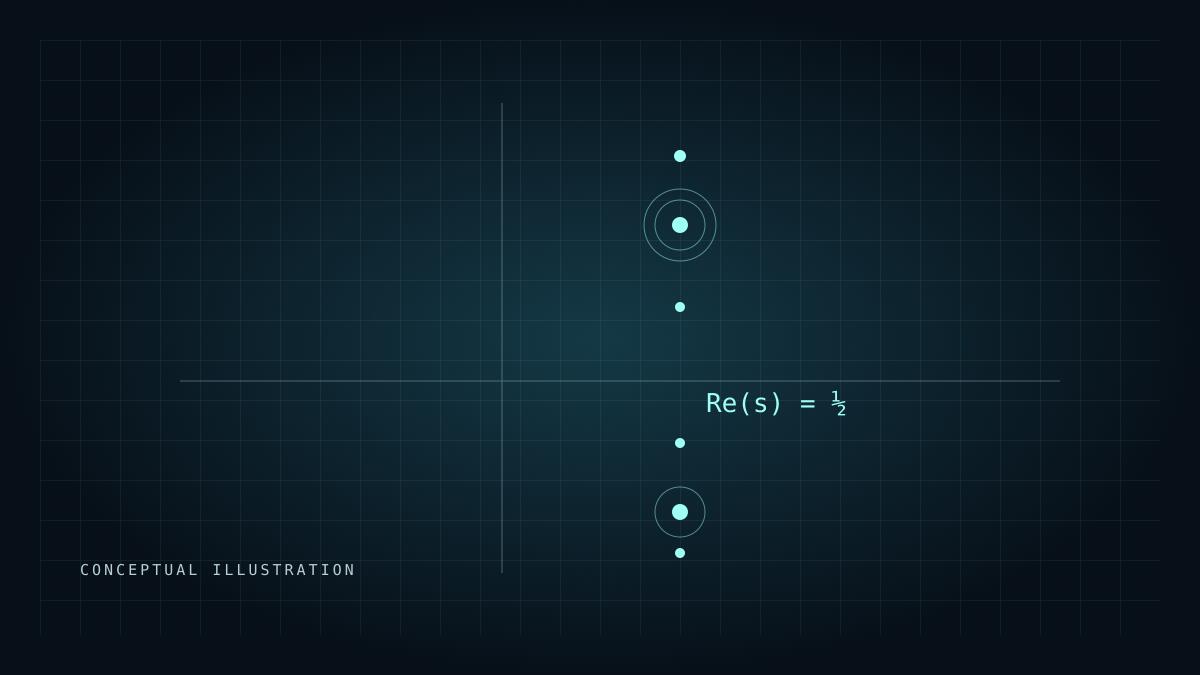
The original hypothesis is about the Riemann zeta function. It says that every nontrivial zero of that function lies on a line in the complex plane where the real part is one-half. The location of those zeros matters because it controls how closely the distribution of prime numbers follows its expected pattern. The generalized version checked here covers Dirichlet L-functions for all moduli and characters. It does not cover Dedekind zeta functions or Hecke and automorphic L-functions in general.
A build is only the first check
In a verification report updated at 12:55 UTC on November 21, MIT mathematician Andrew Sutherland said that all 175,187 modules of the published source compiled, and that every module was replayed through Lean’s kernel, the part of the system that checks proof steps. His audit reported that the five headline theorems depended only on three standard Lean axioms. That matters because even a file that builds can prove a theorem from an assumption that does the work for it.
There is a second trap: proving the wrong statement precisely. Sutherland reported that con-leche’s statement comparison matched all five theorems to the verification challenge, which includes the familiar Mathlib version of the Riemann hypothesis and versions for Dirichlet L-functions. He also reported that two independently written kernels, nanoda and con-leche, accepted the full exported proof. Later that day, the Lean and Mathlib communities issued a joint statement certifying the original Riemann hypothesis proof. They reported that two comparison tools matched the theorem to Mathlib’s vetted statement and that several proof checkers, including Lean’s official kernel, accepted the raw proof export. That statement is about the original hypothesis; it does not by itself certify every broader claim in the announcement.
The next question is whether readers can see why it works
An accepted formal proof is evidence, not a poll of mathematicians’ opinions. The completed checks deserve weight: they address the validity of the formal steps, the assumptions those steps use, and whether the claimed statements match formal targets. They do not explain why the approach works or which of its ideas might transfer to other problems. Alpöge’s announcement describes the argument as very long and says he intends to write it up. That account would give readers a way to study the idea rather than only reproduce the verdict.
At press time, the Clay Mathematics Institute still listed the Riemann hypothesis as unsolved. Its standing listing is not a technical rebuttal to the checks. Likewise, the checks are not a prize decision, and they do not establish Alpöge’s stated expectation about the broader Extended Riemann Hypothesis. The useful development is more specific: independent reviewers can now test an AI-assisted mathematical claim against a public artifact, and say exactly which checks passed.