
A finding, not a finished tool
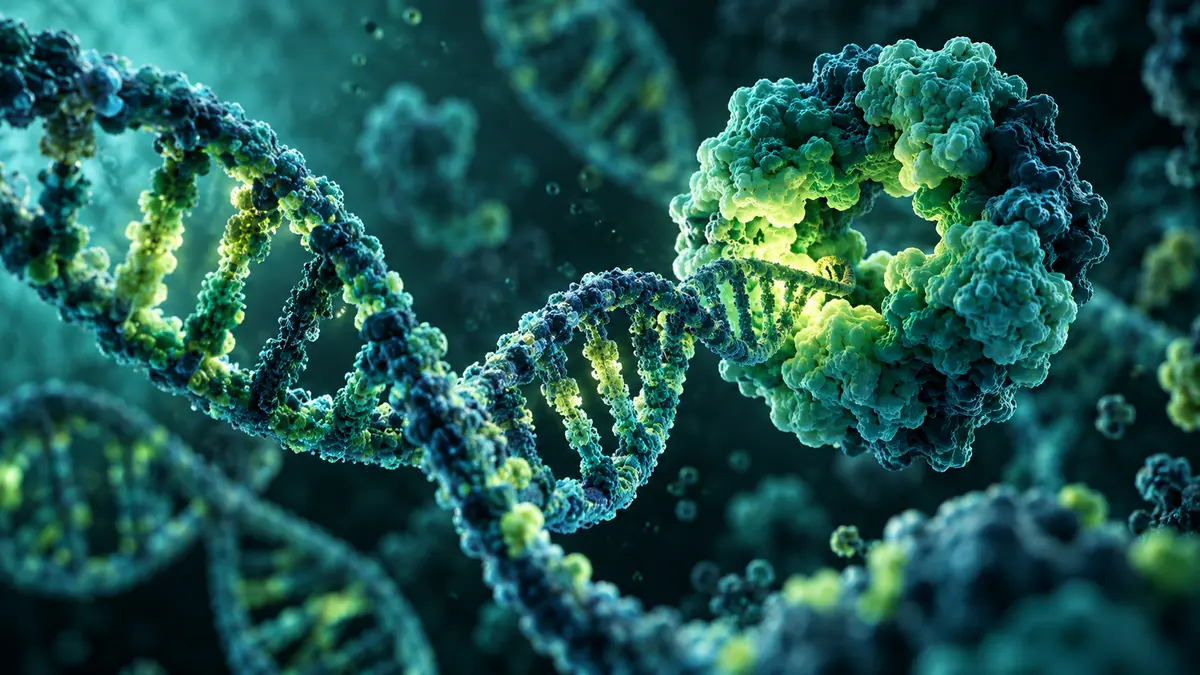
Anthropic's life-sciences group reported on September 23 that Claude-assisted searches of DNA sequence data led to a previously uncharacterized system it calls array-associated reverse transcriptases, or ARTs. The pattern involves a reverse transcriptase, neighboring repeated DNA sequences and an accessory protein whose function is not yet known. The company says human scientists followed up with laboratory work and released a preprint. This is a research result, not a new gene-editing treatment.
The phrase “CRISPR-like” needs care. It refers to a resemblance in the presence of repeat arrays and the broader possibility that unusual microbial systems might prove useful. It does not establish that ARTs work like CRISPR, cut DNA on command or can be deployed in medicine. Anthropic explicitly says it has not determined the system's primary function. Claiming a therapeutic breakthrough now would outrun the evidence.
Where AI enters the scientific loop
Sequence databases are enormous. Researchers can search for familiar genes, but unusual combinations may be missed when no one knows which pattern to seek. According to Anthropic, a collection of Claude agents surveyed reverse-transcriptase families, formed hypotheses and flagged a pattern for people to investigate. The scientists then tested promising candidates in the lab. The value of this workflow is not that a chatbot replaces an experiment. It is that computation may narrow the search space and help people decide which experiments are worth doing.
There is also a selection problem. When an AI system generates hundreds of plausible hypotheses, a striking example may be easier to publicize than the many that fail. Independent replication, biochemical characterization and open methods will matter more than the novelty of the search process.
What would make this significant
The next questions are what ARTs do in their natural setting, whether the proposed components are necessary and how reliably results reproduce in other laboratories. Only then can researchers assess whether the system offers a useful biological mechanism. The larger story is methodological: AI can help scientists notice patterns, but evidence still passes through experimental design, controls and peer scrutiny. NEURA has not examined the underlying lab data independently. Treat this as a promising early finding with an unresolved function, not as an approved technology.