
What is actually being tested
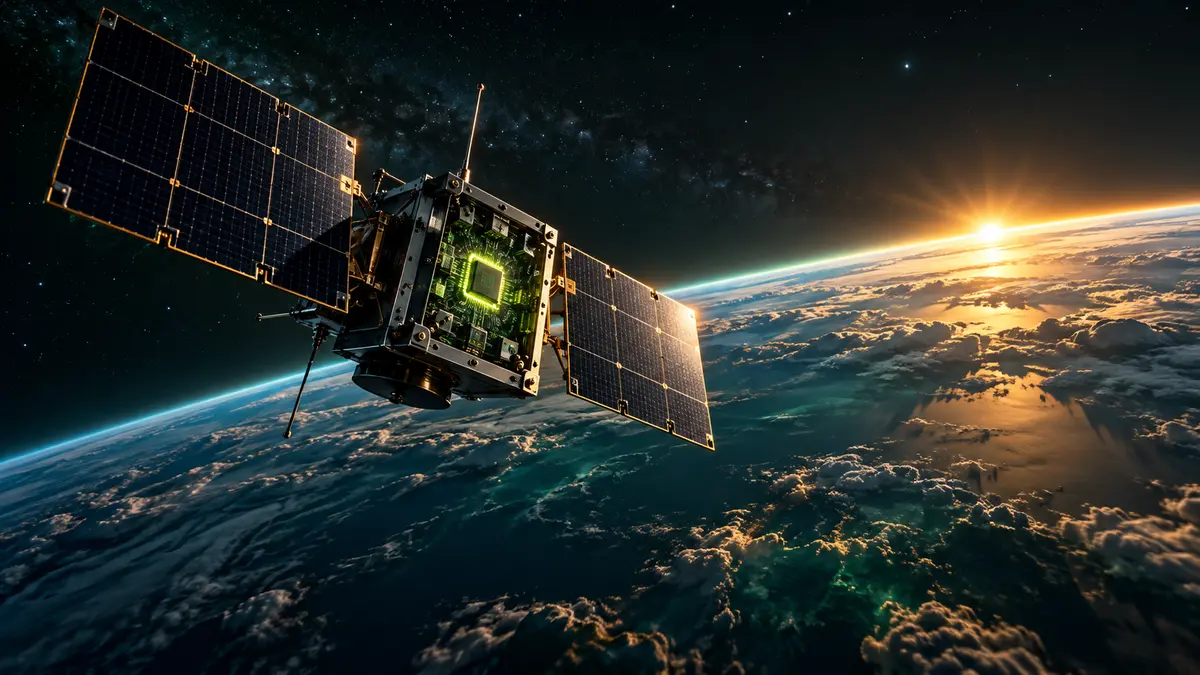
Google said on September 24 that Project Suncatcher is preparing an initial satellite test to see how its Tensor Processing Unit hardware behaves in orbit. The project explores a long-term idea: using abundant orbital sunlight and clusters of satellites to support machine-learning computation. The upcoming experiment is a prototype hardware mission, not a functioning AI data center in space. Launch plans can change, and an orbital test should not be described as a result before it has flown.
The attraction is straightforward. Solar energy is plentiful above much of Earth's atmosphere, and Google says low-Earth-orbit satellites can experience near-constant sunlight under suitable conditions. But generating electricity is only one part of a computer system. A useful orbital cluster would need to survive launch, handle radiation, remove heat, communicate at high bandwidth and justify costs over terrestrial alternatives.
The difficult engineering
Google describes vibration and acceleration tests for the prototype and radiation work involving TPUs. Laboratory survival is encouraging but cannot reproduce every condition of a mission. Cooling may be harder than it sounds: in a vacuum there is no ordinary airflow to carry heat away, so designers must rely on approaches such as heat pipes and radiators. Heat management is essential for dense chips that must operate reliably over time.
Networking is another constraint. Future clusters would need laser links between moving spacecraft. High bandwidth at short orbital distances demands precise pointing and coordination. Google says a later test involving two satellites is planned for 2027. That means today's prototype does not validate an interconnected compute constellation.
How to read the milestone
The sensible question after launch is not “Did Google build an orbital cloud?” It is whether the test produces credible data on chip operation, thermal behavior and resilience in space. A series of successful prototypes could gradually strengthen the case for a larger system. Failed or mixed results would also be valuable engineering information. Google has not shown that the economics, maintenance cycle or environmental trade-offs of orbital AI compute beat Earth-based infrastructure. For now, Suncatcher is a research bet with unusually visible hurdles and a small first experiment.